

Big Bands are punk rock
Listen to the Kenny Clarke/Francy Boland Big Band and thank me later.

A while ago, Nick Hornby wrote a column for The Believer about his foray into big band music, in search of joyful noise during the pandemic, and described a particular Woody Herman track as giving him “the same kind of thrill that punk rock used to provide.”
There’s a riff, and then the trumpeters let loose with a rapier-like set of controlled slashes. When the rest of the horns join in to egg them on with a sneaky, funky chart, they effectively set the Basin Street West jazz club, where the album was recorded, on fire. You can even hear a member of the audience let out a loud whistle, the kind that involves fingers, either because he’s trying to express his excitement or because he’s attempting to call the emergency service.
I was so grateful for the comparison and the reclaiming of a genre with a reputation for antique mustiness. He goes on to highlight a modern practitioner, Maria Schneider, but that sense of punk-rock power is how I often experience Count Basie, Duke Ellington, Herman, and the Thad Jones/Mel Lewis Orchestra, especially on the live records. The repeated body blows of big horn punches, the raw and barely tethered energy of a dozen or more players swung around by a hard-working drummer. I recall Whitney Balliett describing seeing the Basie band for the first time in a narrow, low-ceilinged club and feeling like he was in a wind tunnel, overwhelmed with sound. A mosh pit would not have been an unreasonable response.
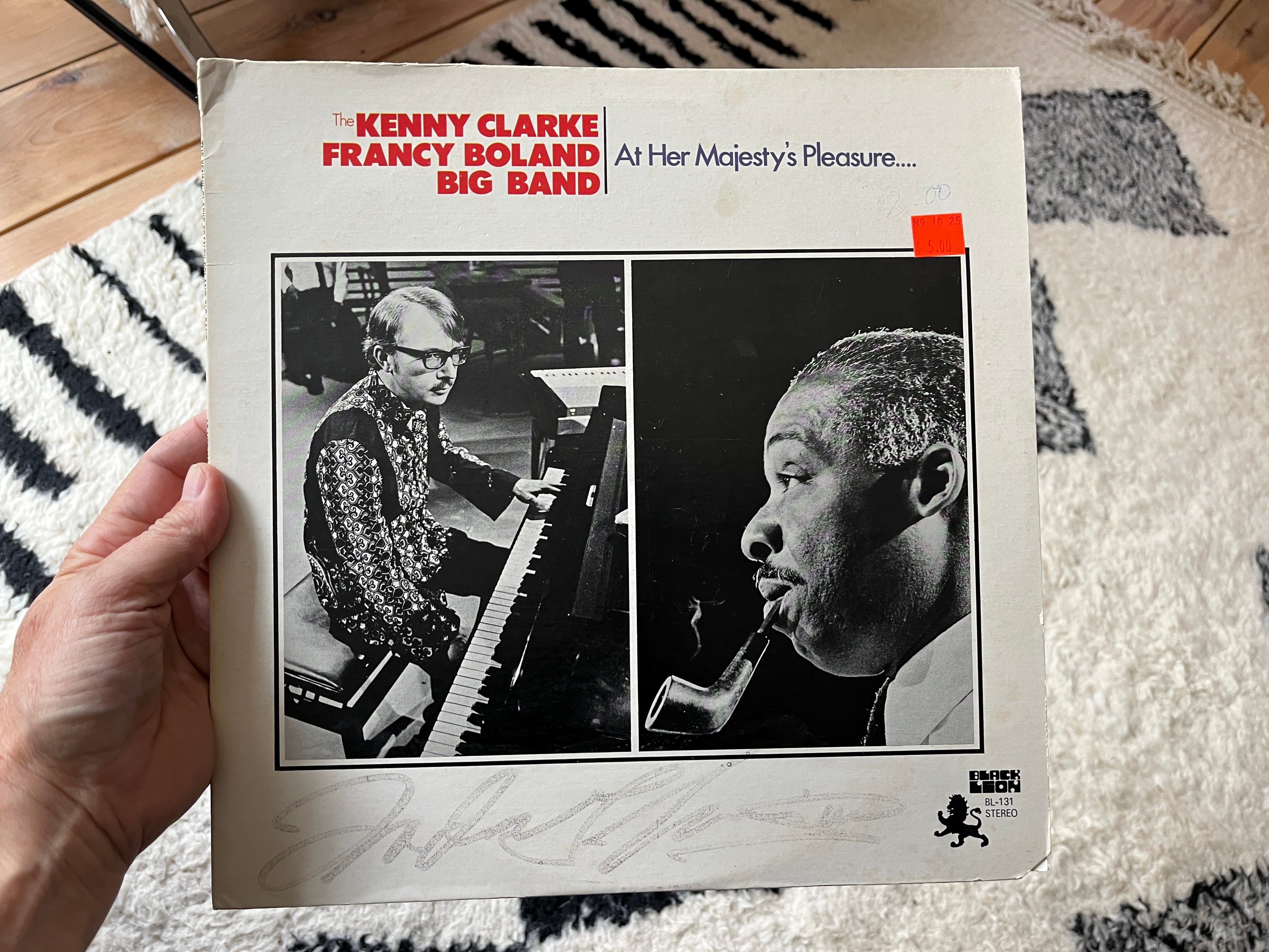
If I recall correctly, I wrote to Nick to recommend the Kenny Clarke Francy Boland Big Band, which formed in the late 1960s from a mix of European and American ex-pat players. They are, in spirit, like the Clash coming along to revive rock ‘n’ roll— unpredictable, hard-charging, outrageously exciting and powerful. If you thought punk rock was an underdog in its time, consider the big band revivalists of the 1960s and ‘70s! (To judge by how little a Woody Herman record goes for in modern shops, big bands apparently remain underground and practically off the grid.)
Francy Boland’s arrangements are modern, kinky, swinging, swerving like the car chase in The French Connection, powered by a double drum attack (the other drummer, confusingly, is named Kenny Clare), with soloists who can really peel the paint (Johnny Griffin, Benny Bailey, Ronnie Scott, Sahib Shihad).
Highly recommended is this 1969 LP recorded in Germany for the Black Lion label, Of Her Majesty’s Request…
Given its title, I’ll go ahead and declare it the God Save the Queen for the big band revival scene. These guys were hardcore: Two of the songs are named after UK prisons, one of which, Pentonville, Johnny Griffin landed in for alleged tax evasion upon arrival at Heathrow airport. With the help of local patrons, he got out in time to make his gig at Ronnie Scott’s. Afterwards, Boland, a Belgian pianist, conceived and arranged this entire record themed to criminology and imprisonment, with songs like “Doing Time” and “Going Straight.”
Enough blab, just have a listen.
I’m a bit late to some of your essays, but by sheer coincidence I was listening to the Clarke Boland Band’s Fellini 712, their tribute to the Eternal City. Albums by these guys take up almost half a shelf in my collection, and while I certainly get your punk rock analogy, for me Francy and Kenny and their cohort represent a peak of modern jazz sophistication. Cheers!
when a big band is steered right it will beat your ass.