

This Time of Year
A Christmas album for lonely grownups.

Today, Record Lung presents a Christmas meditation—and vinyl deep cut—from David Garland, musician and artist, and former host of WNYC’s “Spinning on Air” from 1987 to 2015. He is also a Hi-Fi Villager.
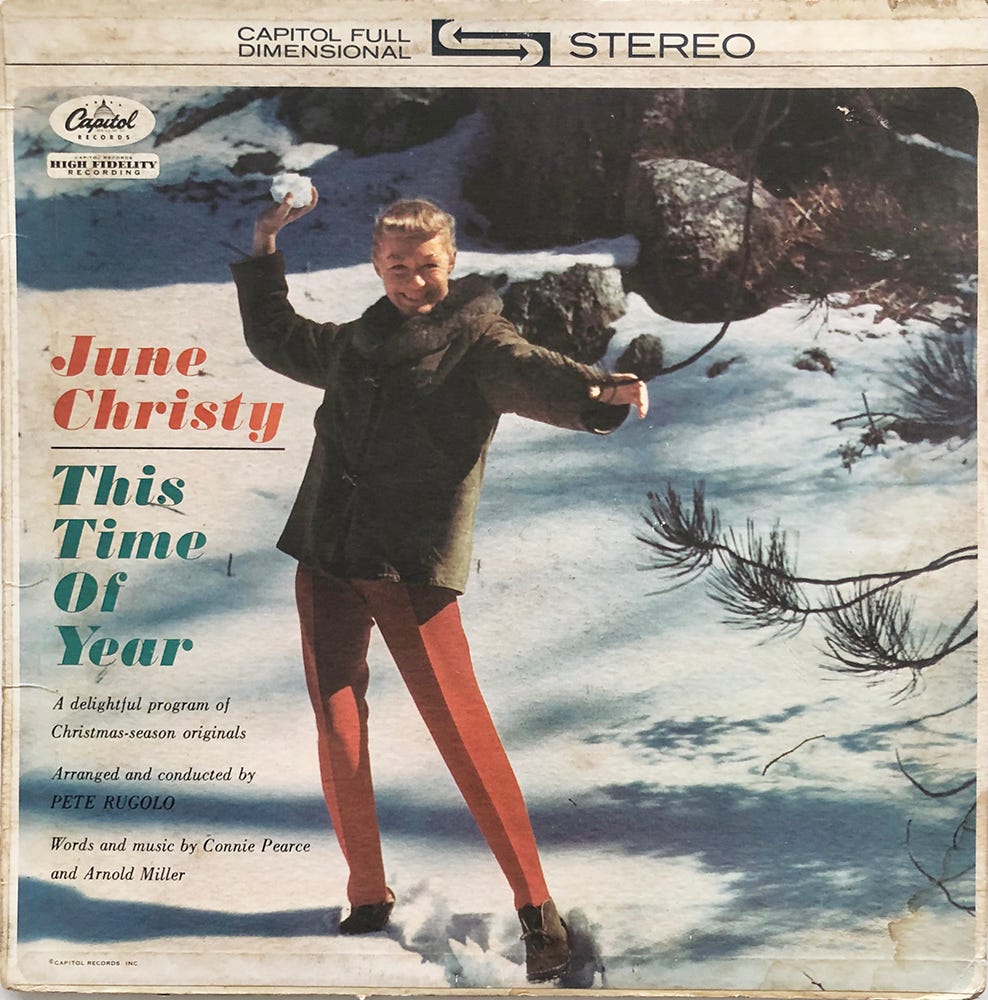
One can be content—or hopefully even happy—on one’s own. As a widower, I try to stay positive. But merry? Merriness implies an interaction—a synergy of my joy and yours, amplifying one another, giving us something magically more than we could each bring to the situation alone. How wonderful! How pretty to think so!
The pleasure of that magical synergy is the stuff of merry Christmases. But death, divorce, disaster, disappointment, disenfranchisement, and dissolution can disrupt the joy of that December connection, making it … difficult. That’s the stuff of disgruntlement.
Bah, humbug!
In January 1961, jazz singer June Christy—who’d made a career out of the poignant mix of joy and sadness her voice so effectively conveyed—joined the cream of a West Coast crop of super-competent, chart-reading jazzers in Capitol Studios (the Los Angeles building designed to look like a stack of LPs) to cut a different kind of Christmas album.
Three years earlier, Christy, formerly a vocalist with Stan Kenton’s modernist band/orchestra, had recorded the moody “Night Time Was My Mother” on her album, The Song is June! That song was written by the wife-and-husband team of Connie Pearce and Arnold Miller. Those thoughtful songwriters apparently only got a couple of breaks. In addition to their work for Christy, they wrote the title song for singer Alan Copeland’s album No Sad Songs for Me, issued on Coral in 1957—a bit of an outlier in their small public oeuvre, since their sad songs shone. Their next opportunity was to create an unconventional Christmas album for June Christy.
That album was This Time of Year, arranged by the very talented Pete Rugulo, who studied with composer Darius Milhaud, and arranged for Kenton and many others. The album was recorded with incredible state-of-the-art finesse by producer Bill Miller and an orchestra of some of the West Coast's best: Christy’s husband Bob Cooper on tenor sax; Bud Shank, alto; Paul Horn, flute; Russ Freeman, piano; Red Mitchell, bass; Shelly Manne, drums; etc., etc., released later in 1961. The stereo version of the LP paints a vivid sonic picture of these great players all in a room together.
This Time of Year is a Christmas album for lonely grownups. That probably was and is a big demographic, but not one that record companies usually catered to, if they acknowledged them at all. After a brief, bittersweet instrumental intro, the album begins:
Oh, Christmas, I would like to give a friend to every lonely heart
A peaceful country stream to the folks afraid to dream—that would be a start
This is a concept album that tells a story, moving from loneliness to gentle hope. It’s a Christmas album without familiar songs, kindly unburdening the listener of any cloying or depressing holiday associations.
As a singing narrator, Christie is feeling someone’s absence. She was in her mid-thirties at the time, and that suits the narrative.
It’s a terrible disgrace, all this trash around the place
As the end of the year is drawing near
These are things I can’t discard, but it shouldn’t be too hard
To find a way to use them, since I can’t give away or lose them …
I’ll take the quarrels of last September
Cold little words all sad and gray
Cover them with a silver spray, and hang them on the tree
Every worry, every fear, I’ll tie on a string with every tear
Watch them dance in a Christmas light:
A year’s worth of troubles, shining bright
There’s a nice swing implicit in the lyrics’ uneven cadence, and the music is upbeat. She’s trying her best. Later, she’ll sing:
This time of year I feel better alone, I ignore the telephone
What’s the use of making all the old excuses friends don’t care to hear?
So I sit and listen to the party going on next door
I admit that I thought twice before deciding not to go
The laughter sounds so nice
I’ve heard actors say that it’s more poignant and affecting to hold back tears than it is to let them flow. The point is: It’s been rough, but let’s be grateful.
Midnight will sound, and we’ll all gather ‘round the new little year of the day
But dear old year, before you go, here’s something you ought to know
Though your back is bent, and your beard is gray, you’re a year well spent
And I’d like to say: You put on a first-class show, and I’m sorry to see you go
You brought trouble, taught me to handle it, thanks for the lesson
You brought romance—oh what a scandal it caused when it all fell through!
You brought worry, taught me to laugh at it
Now I’m confessing that my whole approach is new, after a year like you
So we’ll share a toast from the loving cup: Here’s to you grown old, and to me grown up!
Rugulo’s arrangements are full of subtlety and inventiveness, and the songs’ mix of emotions is given appropriate colors. The vocal lines arc and weave in ways that push the envelope, but don’t impose eccentricity. Compassionately acknowledging the challenges of fortitude, the album concludes:
So the season makes you sad and sentimental
Memories it brings to mind are things you’d rather leave behind
Little lady lonely, don’t you grieve, winter’s got spring up its sleeve
There’s another chance, if you can hold on. A very reasonable, seasonable wish, and a good one to hear when presented this way.
 | A guest post by
|
The Merriest is the second song on my Christmas list, called "Holidose"
I really like this album, although I don’t include it in my Christmas mix playlist. One of the reasons I’ve fond of it is that it is all originals-no carols. I don’t think anyone was really doing that at the time.